
The biggest book I own is the Norton Shakespeare, Second Edition. It’s all the plays, annotated: 3,600 pages. Lately I’ve used it to prop up my computer, to enable a more flattering angle on Zoom calls.
In the fall of 2020, I was meeting every week on Zoom with a class taught by the writer Anne Carson and her husband Robert Currie. Anne announced one week that she had quit writing. From now on, she was only going to draw. When you get to be my age, she said, you realize you have run out of words. You shouldn’t say that, Currie said. They’ll think you’re serious.
I am serious, Anne said. She has since published three books.
In early 2023, I lost a writing gig to ChatGPT. A few months later I was hired to help write an online history textbook. Tens of thousands of words of my copy on the Progressive Era were thrown out for being “anti-business.” The company’s founder writes in his introduction to the unit on the Gilded Age—a period named to describe the conspicuous consumption of the new industrial class—that, thanks to the reforms of Teddy Roosevelt, the age was “not Gilded but Glittering.” I guess not all that glitters is gilded.
Privately, I had decided to give up writing. My compulsive notebooks turned into sketchbooks. I kept thinking of the Goethe quote I encountered in Aldous Huxley’s The Doors of Perception (1954):
I personally should like to renounce speech altogether and, like organic Nature, communicate everything I have to say in sketches. That fig tree, this little snake, the cocoon on my windowsill quietly awaiting its future—all these are momentous signatures. A person able to decipher their meaning properly would soon be able to dispense with the written or spoken word altogether.
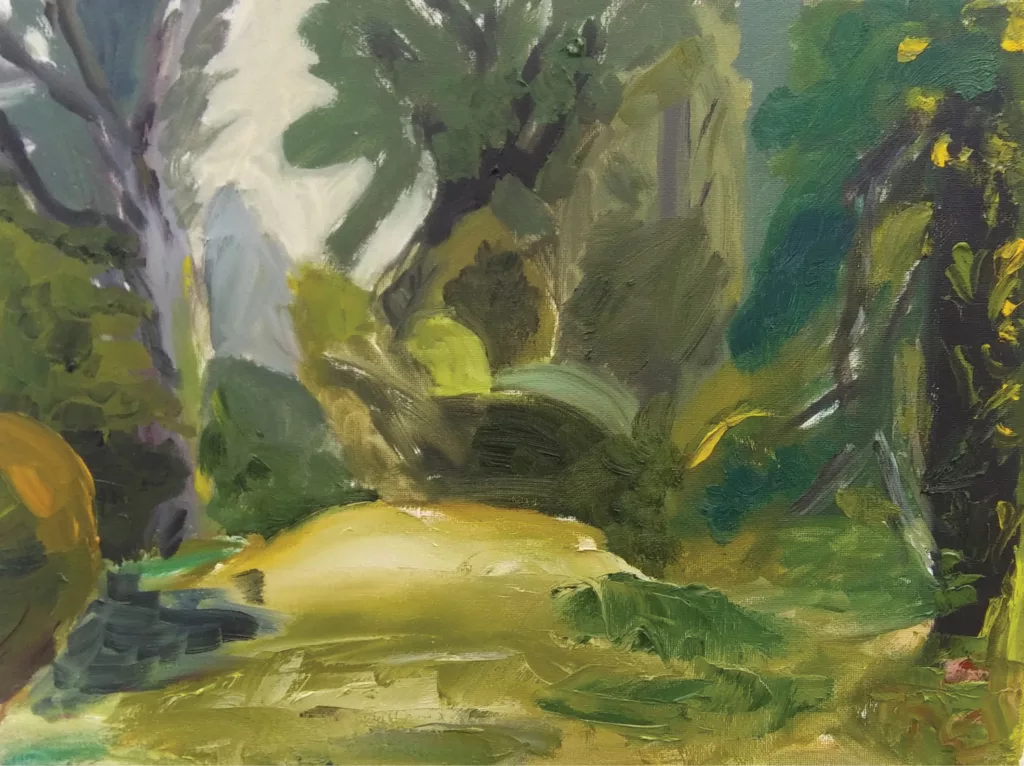
In the summer, I enrolled in a two-week intensive landscape painting class. Every morning I got on a chartered bus in Greenwich Village and rode with ten or so students to Long Island. For ten hours a day we painted on the grounds of a 200-acre garden that was once a robber baron’s estate. We used a 32-color palette. (Mine only had 29; I couldn’t track down caput mortem, peach black, or emerald green.) We made four or five paintings a day, all of us set up with our French easels in remote parts of the grounds. The class was taught by Graham Nickson, the acclaimed British painter and dean of the New York Studio School. Graham zipped around in a golf cart driven by a TA, advising us on how to see better. Once you capture a shape, he said, it’s easy to turn it into a logo. Instead, you must rediscover what it is.
Privately, I had decided to give up writing.
A painting is the record of an experience, Graham said. Out there in the June woods and gardens I went through tubes and tubes of greens: cool, deep-space veridian; warm chrome oxide; sap green (the closest I could find to emerald); earthy, low-staining terre verte. Graham said that Mondrian began by painting trees. His eyes twinkled: Those who paint trees every day eventually forswear green altogether. By the second week, I was mixing a whole second palette of only greens: every blue with every yellow; blacks with yellows; pre-mixed greens with grays, violets, cadmiums, earth pigments.
Everyone was lovely to me although I was a dilettante and they were real painters. On the bus I talked to Ginny, who came from Scotland for the class. She had a dual graduate degree in painting and philosophy. She said, What a luxury it is to spend all day thinking about color.
We were on another planet, one where usefulness was not a concept. We worked with the urgency of scientists, survivalists. Bugs in our paint, grit in our paint. Sun-fried because it was too cumbersome to reapply sunscreen while smeared all over with paint. When a sudden summer shower came on, half the class stayed out on the grounds to get at the storm light. Lenore worked in the rain, massaging handfuls of viscous oil and pigments onto a five-foot canvas, as if trying to patch together some rift in the world.
Lenore was an actor for decades and had just finished her MFA in painting. She carried canvases as tall as herself by the stretcher bars, wheeling a hundred-pound bag of paint tubes into the field, white-gold hair falling from a loose-clipped bun. How did Cézanne do it, she wondered aloud, when he was old and sick?
At the end of week two, Lenore and I were the last ones left in the downtown studio at 9 p.m. She walked in on me crying over the slop sink, cleaning my brushes. I was almost too tired to feel embarrassed. My lungs and eyes stung from a cocktail of turp fumes and wildfire pollution. Come, Lenore said, let’s talk. We sat facing two of her big canvases: the one she did in the rain and another of the same tree. Pathways through sky and trunk and foreground found and found again in blues and earth tones until they accumulate form. I don’t want to go back to real life, I said.
What is it, she said, that you found here that you don’t think you can find in real life?
I tried to put it into sentences and then gave up. I wanted to dry my eyes, but every part of me was covered in paint or solvent. I’m just so sick of language, I said.
Lenore nodded, like she knew just what I meant.
There’s a Joanna Newsom lyric from The Milk-Eyed Mender (2005) I have thought about nearly every day since I first heard it. “And the signifieds butt heads with the signifiers / And we all fall down slack-jawed to marvel at words.” I love that the signifieds and signifiers are separated by the verb butt heads which, when sung, sounds almost like the plural noun buttheads or maybe the possessive Butt-Head’s as in Beavis and . . . But the next line is the kicker. “While across the sky-sheet the impossible birds / In a steady, illiterate movement homewards.”
My resolution to stop using words was an imperfect one, given that my income depended on the use of them. Not to mention I would spend the rest of the year paying off the debt from the painting tuition and materials and the hours I spent painting instead of working. Shortly after the painting class I went into the office on a Saturday. Instead of working, I fell asleep on the couch. When I woke up, the Empire State Building was a smear of green light in the orange smog of dusk. My lungs were heavy. I got up to close the windows. Flakes of ash drifted in, all the way from Canada, I guess.
Instead of writing, I opened an advance copy of the new Naomi Klein book, Doppelganger. I’ve read most of Klein’s books because there is something about them I find both urgent and soothing. She writes about the present as if it is already history: a thing able to be narrativized, understood. Her 1999 debut No Logo came out of her reporting on the abhorrent conditions in the Chinese factories that manufacture products for companies like Nike and Apple. Back in North America, Klein was struck by the way these companies’ advertising campaigns appropriated signifiers from countercultural and radical movements: Vietnam protest songs to sell Nikes, the faces of Gandhi and Martin Luther King on Apple billboards. She began to study the way companies use branding to obscure the material realities of their products’ manufacture. No Logo deconstructs the way corporate branding warps reality in the service of profit, and how it usurps the place of genuine culture, the discourses we use to describe what we see. Klein’s follow-up, The Shock Doctrine (2007), expounds a theory of what she calls “disaster capitalists”: the politicians and corporate actors who use military and ecological crises as opportunities to enrich themselves and hollow out the public sphere.
Klein has a gift for calmly untangling double-speak, so it’s unnerving that her newest book is about her own panic and speechlessness in the Covid years. We see her neglecting her family for Twitter rabbit holes. She is addicted to Steve Bannon’s War Room. The catalyst of her personal crisis is the titular doppelganger, Naomi Wolf, with whom Naomi Klein is so frequently confused on the internet that Klein was barraged by notifications every time Wolf tweeted a new pandemic conspiracy theory. (Wolf was deplatformed in 2021.)
Klein and Wolf are both Jewish brunettes named Naomi who became famous public intellectuals in the 1990s. But the proto-Lean In feminism of Wolf’s first book, The Beauty Myth (1990), is diametrically opposed to Klein’s idea of feminism as one tool in the struggle to dismantle systems of economic exploitation. No Logo is critical of the way identity politics can distract from more radical agendas. When marginalized groups demand “representation”—in the media or the boardroom, say—they are mistaking a mirage for material progress. Naomi Wolf, on the other hand, was a longtime advocate for both the Democratic Party and women’s access to corporate leadership roles. In recent years, she has become a darling of the alt-right. She appears frequently on Bannon’s War Room, lending a sort of liberal feminist credibility to a crusade against the system of “vaccine passports” imposed on American citizens by the Chinese Communist Party. The internet frequently credits Wolf with authoring The Shock Doctrine, a book she sometimes cites to support her theory of the pandemic as a smokescreen for the CCP plot to inject us with “nanoparticles” that track our movements and make us contagiously sterile.
The Wolf-Bannon alliance is an example of a rising phenomenon that Klein labels “diagonalist politics.” It is a product of the internet-enabled “mirrorworld” of conspiracies that make strange bedfellows of New-Agey liberals and fascists. The problem runs so deep it infects language itself. Klein borrows the term “pipikism” from Philip Roth’s Operation Shylock. (The term is derived from a Yiddish word for naughty children that also means bellybutton.) Roth describes pipikism as “the antitragic force that inconsequentializes everything.” Pipikism, Klein writes, describes what is done by “all the monstrous clowns that have reshaped modern politics in recent years.” For example:
[W]hen Bannon states that his armed and authoritarian posse is being “othered” by leftists and liberals, he is appropriating an important term that analysts of authoritarianism have used to describe how fascists cast their targets as less than human . . . He is also making a mockery of the whole concept of othering, which in turn makes it harder to use the term to name what Bannon does as a matter of course—to migrants, to Black voters, to trans and nonbinary youth.
Trump pipik-ed the very real phenomenon of “fake news.” Tucker Carlson pipik-ed the word “genocidal” when he used it to describe media that is critical of white people. “Is it possible to escape the tractor beam of pipikism?” Klein asks. Conspiracy theories about the CCP discredit real revelations of corporate profiteering off of vaccines and no-touch technologies. How can you bring yourself to speak when anything you say becomes the opposite of what you mean?
“I had been thinking that my speechlessness was the result of my own highly specific Naomi-Naomi problem,” Klein writes. “But it turned out that, in this time of great loneliness, a lot of us were watching the world go by with our mouths hanging open.” We have entered a period, she argues, of “near violent rupture” between words and the world, a time of “confusion between saying/clicking/posting and doing” and between “the virtual nature of our lives in the blue screens and the reality of embodied labor . . . and material inputs (oil, gas, coal . . . ) that makes it all possible.”
In recent years, left social movements have won huge victories in transforming the way we talk about all kinds of issues—billionaires and oligarchic rule, climate breakdown, white supremacy, prison abolition, gender identity, Palestinian rights, sexual violence . . . and yet, on almost every front, tangible ground is being lost. Changing the discourse did not prevent the world’s ten richest men from doubling their collective fortunes from $700 billion to $1.5 trillion in the first two years of the pandemic; it did not stop police forces from increasing their budgets while teachers have to pay for basic supplies out of pocket.
The list of what progressive rhetoric has not achieved goes on and on. The left changed the discourse, Klein concludes. “But we appear to have done it at the precise moment when words and ideas underwent a radical currency devaluation.”
Last summer, while visiting my family in Illinois, I decided to teach my niece how to draw and paint from life. I guess this isn’t something people usually set out to teach five-year-olds, whose imaginations are more precious than what’s in the world. But she understood the concept right away. We sat at the kitchen table, and she painted a turtle with pink hair floating above the ocean. In the center of the table there was a drinking glass full of wildflowers. That’s a good turtle, I said, now let’s paint the flowers.
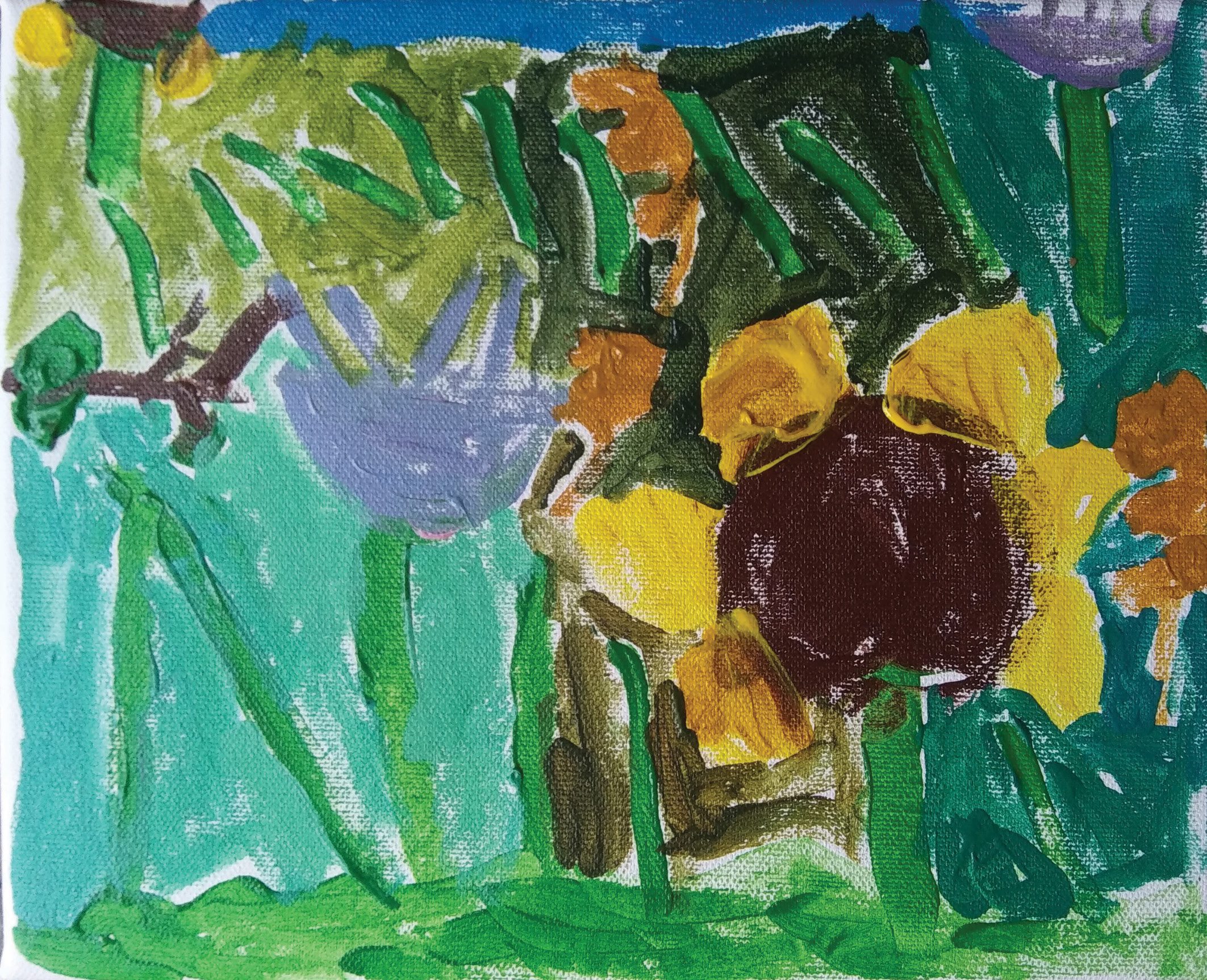
How do I start?
What’s the first thing you see?
This petal.
Okay, paint that first.
She made a noise like woo-doo-bloo-bleedah, to help her find the contours of the outline. What do I do now? she said.
What else do you see?
This petal.
So how can you connect that one to the one you just painted?
That’s easy, she said, It’s like a wave. It’s like wooooo-blee-blah.
I wondered if she had access to some primeval language, some direct connection between movement, sound, and mark. At other times, she used nonsense syllables to stand in for words she hadn’t learned. She knew I’d understand what she meant, as long as she kept the rhythm of the sentence. Can you push me in the ta-ta, she said, pointing to the hammock in my mom’s basement. I don’t have a ta-ta at home, she said, so I always forget the words.
Sometimes she wanted my attention although she had nothing to say. She threw her arms around my neck or headbutted me in the stomach and then made noises that were not English (nor German, which she also speaks). Or she looked around the room and inserted random objects into sentences like MadLibs. Taking my hand: Do you want to go to the window? Do you want to go to the lamp? Do you want to go to the garbage?
Somehow my niece’s Dada gibberish made language more meaningful to me rather than less. In Doppelganger, Klein cites Greta Thunberg’s commentary on the 2021 Climate Summit, in which Thunberg, when interviewed by the press, used the phrase blah, blah, blah with a repetitiveness verging on performance art. “Build back better. Blah, blah, blah. Green economy. Blah blah blah.” Thunberg was ridiculing the empty promises of global leaders. But she was also, Klein writes, preserving real words “for spaces where they still might matter.”
When I returned to New York from Illinois, I opened my Norton Shakespeare for the first time all year. Pressed flowers fell out of the Twelfth Night pages: tulips and spray roses from old still-life setups. I was looking for the “words, words, words” line in Hamlet, from that scene where he is pretending to read a book while pretending to be crazy:
Polonius: What do you read, my lord?
Hamlet: Words, words, words.
Polonius: What is the matter, my lord?
Hamlet: Between who?
The joke hinges on two denotations of the word matter, which here can mean either content or conflict. Maybe Shakespeare is saying that meaning is always conflictual. The signifieds butt heads with the signifiers.
It occurs to me now that what I am describing is simply poststructuralism, the underpinning of most philosophy of the later twentieth century. I am trying to remember what I learned in my undergraduate critical theory class. Circa 1900, the Swiss linguist Ferdinand de Saussure invented structuralism, the idea that each word is a “sign” composed of two components: the “signifier” and the “signified.” In Platonic philosophy, a word corresponded to an ideal form; a word had an essential meaning. But Saussure opened up the possibility that the relationship between signifier and signified was arbitrary. The “poststructuralist” thinkers who followed in his wake argued that this relationship was determined by systems of power. That is, the people in charge shape the “matter” of words in a way that perpetuates their own authority and profit.
I have just attempted and erased several paragraphs about Foucault, Deleuze, Derrida, and Spivak that I am not really smart enough to write. When I think of Klein’s understanding of “pipikism,” I think of the way power absorbs critiques of power, renders them meaningless. Because I spent my most formative years reading the words of Jesus rather than poststructuralist theory, I think about Christianity, which began as a critique of the Roman Empire and a call to radical nonviolence, and was, in three centuries, absorbed by the Roman state itself. For a thousand and more years thereafter, it was the ideological glue of warrior aristocracies, and then of racist empires committing atrocities of unprecedented scale.
I’d wager Jesus understood the risk of being pipiked. Nobody knows what Jesus really said; the sources we have are incomplete or contradictory secondary or tertiary accounts, rejected or canonized to suit the Roman church. I like to think Jesus tried to protect his language with absurdities, tautologies, contradictions, impossible metaphors that make a fool of anyone who tries to impose authoritative interpretations.
I’d wager Jesus understood the risk of being pipiked.
Maybe all great spiritual teachers try to elude structures of power by skirting literality. Jesus reportedly said a lot of outrageous stuff. Some of it is pretty hilarious. “Let the dead bury the dead,” for example, or “If anyone comes to me and does not hate his own father and mother . . . he cannot be my disciple” or “If your hand or foot causes you to stumble, cut it off and throw it away.” One of my favorites: “Unless you turn and become like little children, you will not enter the kingdom of heaven.”
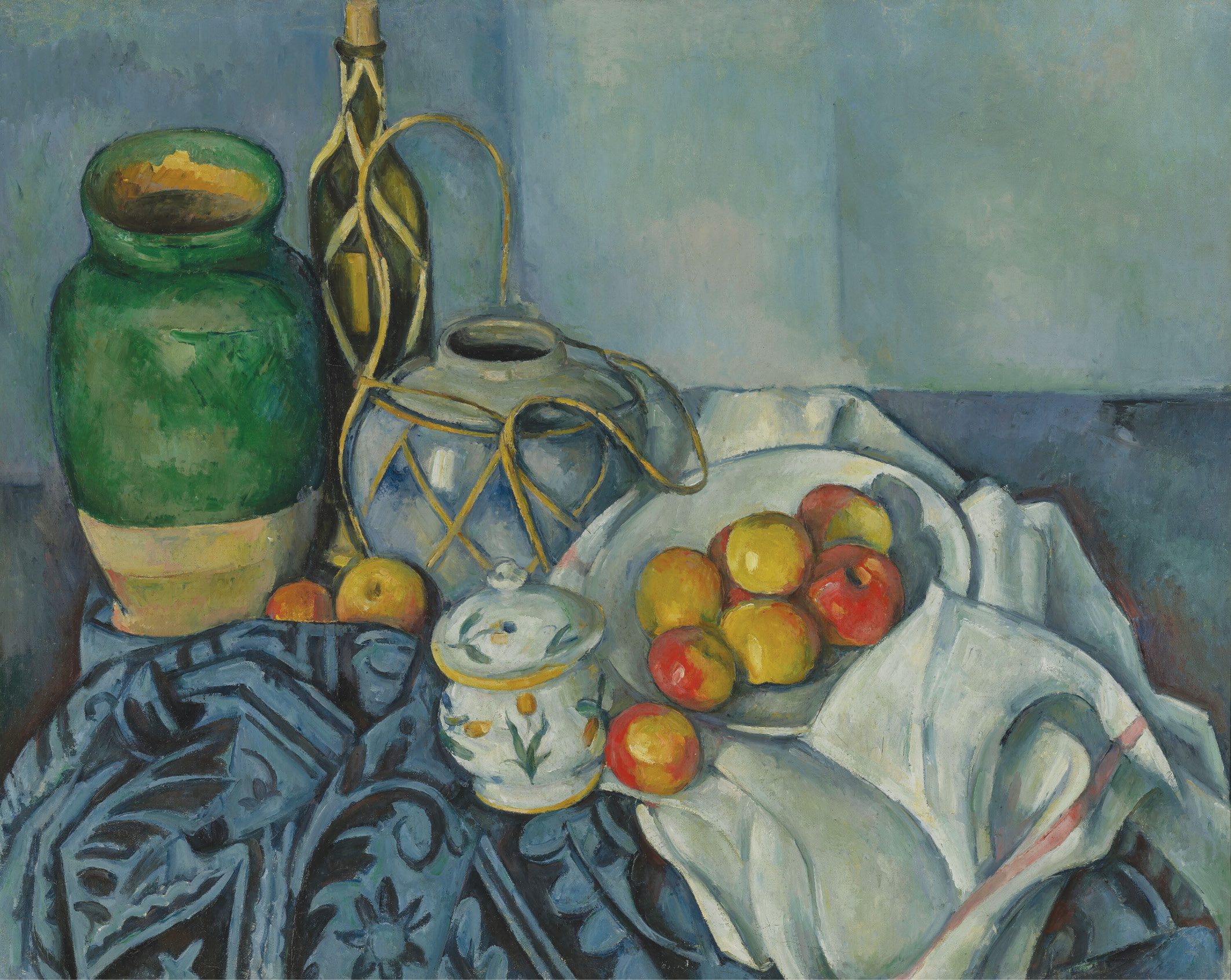
In 2010, the art historian T. J. Clark famously declared “Cézanne, whose work was the touchstone for critical thinking and writing on art for more than a century, cannot be written about anymore.” In 2022, Clark published If These Apples Should Fall: Cézanne and the Present. It is a difficult book to summarize. Clark writes in a way that is very close to looking. He looks very hard at the paintings until an idea begins to form, but then he scraps the idea and goes back to looking. You might say his writing is hard to grasp, and yet he is concerned with the graspability of the visual. He writes at length of the blue cloth which appears across many of Cézanne’s still lifes, creating the sense of a shared universe. “What kind of tangibility or intangibility does [the blue cloth] possess?” Clark asks of Still Life with Apples (1893–94). It is material, he writes, as in a textile. But is it “ontologically” material? “Cézanne was convinced, and his paintings convince us, that colour and contour—the being of things in the eye—do offer us the best, the only real, picture of things as-they-are. But is this because it grants access to objects’ materiality? Or to the objects’ being-for-us as representations—as entities that are the more real for us because they are impossible to grasp?”
Here Clark alludes to the Marxist concept of alienation—the idea that, under industrial capitalism, ascendent in Cézanne’s time, objects acquire an unreality. They are no longer objects; they are commodities. We consumers have more things than ever before, but the things are not graspable because they are more concept than thing. We are separated from, as Klein puts it, the “embodied labor” and “material inputs” that make the things available to us. Even an apple is touched by farmers and transporters and stockists whose lives I know nothing about, shipped to me using fossil fuels mined from places that will never be revealed to me. Because of this alienation, there is in Cézanne’s time, as in ours, “a special pathos, a dislocation—a nowhere-ness,” which manifests in the way he sees. Rilke was the first to diagnose it when he wrote in a 1907 letter of the “bourgeois blue” of the blue cloth. “I don’t believe Marx believed such questions about the reality of the object-world arrived for the first time with industrial capitalism,” Clark writes. “But he thought that the paradoxes had been sharpened.” The ungraspability of the world is a symptom of capitalism. Perhaps it is also a symptom of language.
To devote one’s life, as Cézanne did, to understanding the graspability of things as pictures requires an intensity of concentration which can only be understood as luxury. The final chapter of Clark’s book is about one of Cézanne’s artistic descendants, Matisse. “Matisse was a hedonist,” Clark writes. “And in this he was representative of a central strand in the art we call ‘modern’ . . . Art dedicated to the proposition that the only hope, in a corrupt and invasive culture, is to put one’s trust in the realm of the senses, and to expose oneself utterly—naively, almost idiotically—to the play of light and the pleasure of the natural world.”
Meaningfulness is important. But it is not the same as ethics.
Matisse’s modernism looks apolitical. But he pursued it in opposition to another strand of modernism which Clark calls the “‘Art is dead’ imperative.” The Art-is-dead camp argued that the only way forward was for art to stop being Art and align itself, à la Soviet agitprop, or futurism, with “the practices of craft or design, or of built space, or of public (overtly political) persuasion.”
While his son fought in World War I, Matisse shut himself in his suburban home and painted garden scenes in the tradition of the hortus conclusus, the enclosed garden, an ancient subject which evokes the virgin womb, the mystic heart, the sacred grove. Art, “at such a moment of disintegration and untruth,” Clark writes, “depended on enclosure in a realm of pleasure.” It is there that the unconscious response to catastrophe arises, only “when idiot pleasure is allowed to reveal the pain at its heart.”
The pain in Matisse’s heart is revealed, Clark writes, in Garden at Issy (1917), where all at once the horror is there with him in the garden, in the “earthen sky, with peculiar bright arrowhead clouds . . . casting unlikely shadows sharp as knives.” But the tension of form and direct perception, for Matisse, keeps “the heart of the matter . . . in abeyance.” This is because a painting should not “mean prematurely,” Clark writes. “This is French painting’s essential question. Maturity, meaning the strange deep thing we called ‘meaningfulness’ . . . is just beyond us . . . It is beyond the resources of the culture we belong to.”
Late in life, Thomas Aquinas quit writing. Aquinas, whose synthesis of Aristotelian philosophy and Christianity changed Europe forever, refused to finish his lifelong work, Summa Theologiae. He had seen God. He told his secretary, “All I have written appears to be as so much straw after the things that have been revealed to me.”
In his final years, Aquinas made the steady, illiterate movement homeward. In The Doors of Perception, Aldous Huxley, who finds in this story a corollary to his own psychedelic revelation, calls it “Infused Contemplation.” Most of us, Huxley writes, once we experience this kind of contemplation, are obliged to return to the “straw” and “chaff” of language. “For most intellectuals, such a sit-down strike” as Aquinas’s “would be inadvisable, even morally wrong.”
I would like to ride out the rest of my consciousness contemplating color and form, light through the trees. How purple are the bark and soil enfolded in a hundred temperatures and tones of green. Matisse’s approach to meaningfulness convinces me. Meaningfulness is important. But it is not the same as ethics. Matisse himself believed, as Clark writes, that painting “ought not to pretend it is anything other than a luxury . . . Pleasure is something you pay for, and the vast majority of men and women can’t afford it.”
When I set out to write this, I envisioned it as a hermetic and aesthetically perfect document of refusal. Now that it’s done, I am ashamed of it. In the time it took me to compose this essay, which quotes mostly white people and Jesus Christ, twenty thousand Palestinian people have died in Gaza, while another million are starving to death.
In recent weeks I have spoken with people much braver and harder working than I, activists, who are hesitant to put their thoughts about the genocidal violence and its structural causes into the world at all for fear of jeopardizing their livelihoods, their visas, their lives. Others speak anyway, because they feel they have no alternative, existentially or morally. It is true that we dishonor atrocity by putting it into language at all. But my ability to use whatever words I want, or no words—this too is a luxury.
