
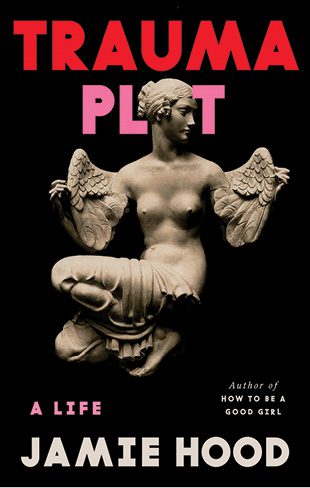
The first thing Jamie Hood tells us in Trauma Plot is when she began to write her memoir: 2016, a year after she had been gang-raped by five men, a month before Trump was first elected. She is quick to point out that “this framing misdirects” because it draws too causal a relationship to that moment and the following decade, which also witnessed the #MeToo movement and its implosion. The ensuing distaste for the “trauma plot”—as the critic Parul Sehgal would describe it in The New Yorker in 2021—has led, Hood argues, to the troubling critical assumption that “there’s no reason to write about trauma except to make a buck.” But for Hood, to avoid trauma as a subject means a “wholesale exile of writers from self-knowledge.”
What Hood sets out to do instead is to find a form to embody her experience: “I wanted my account to wrestle with rape’s dis-ordering. . . . I was undone, and I couldn’t fix it sweeping the fragments into a dustpan. The shards were the book, violent and strange.” Told in four sections from multiple points of view, Trauma Plot portrays Hood moving through the disjunctures in time and setting that are a consequence of violence, both sexual and economic. This description should not suggest an ultimate incoherence to the book but rather its endlessly inventive narrative form.
After a lengthy introduction, Hood starts off with a piece of third-person autofiction, using Virginia Woolf’s Mrs. Dalloway as both an inspiration and a point of departure. Jamie H. is a graduate student trudging through endless student papers and conferences and academic politics as she prepares for a party with her roommate, the older Edie—a fellow drinker, a loving but vague presence. Looming over the festivities are poverty, broken relationships, a predatory professor, career uncertainty, a rape a few months before. A Specter haunts a corner of Jamie H.’s bedroom, reminding her that madness could claim her at any time, for the Specter is very real—and not. “Time was not itself,” Hood writes. “And story outside time had no harmony of experience, no proper subject—it was plotless in short. And what then. The very notion of her self was discomposed. She was all broke up.”
Hood gives us precise descriptions of dissociation, but she avoids “the language of pathology,” as she puts it. “I was resistant to diagnosis,” she writes, “because to have been diagnosed might have forced me to act, and I needed my hollowness.” The second part of the book uses a journalistic first person to describe the aftermath of a second rape, a brutal triple murder in her university’s city, and the Boston marathon bombing, all within the space of less than two years. (Improbably the FBI eventually established an unlikely link between the murders and the marathon bombing.) For Hood, these events form “an unnerving affinity with one another,” and for the reader a reminder that “unanticipated violence” is “utterly unassimilable to the recognizable order of everyday life,” a hollowness that is ours, too, however far away we imagine ourselves from daily violence.
In the hands of a lesser writer, such connections might seem forced. But even in her diary at the time Hood notes, “Historical events displace the individual sense.” It is the dissociation so many of us seek as we doomscroll our own unassimilable moment. For Hood, struggling to find support within her department for a dissertation on postwar women’s projects of self-making focusing on Plath and Sexton, there is a slide into a path of unmaking. She packs up to leave Boston for New York, where the alternative to grad-school teaching is bartending, a stint of sex work. Throughout she is often close to being unhoused. Her living situations are at times horrifying.
The third section, the book’s briefest, is written in the second person although it includes snippets from Hood’s diary. “I must learn to live alone,” she writes as she begins this period of retrenchment. “I will never love. Remember: exorcise desire.” Slipping away from the PhD, she finds herself ricocheting between drink, drugs, casual sex, undereating. “Debridement” is what Hood calls this self-annihilation. She also gravitates simultaneously toward self-repair without any sense of false hope: yoga, bike rides, long runs. Importantly, she eventually acquires a most beloved dog.
“You must ‘come back to writing you must make art—don’t slide into the hole, don’t dissolve again,’” she exhorts herself—and us. Throughout we, too, experience the self-
division that roils her life. The odds against the book we have in our hands seem long. What makes them seem truly insurmountable is a third rape, this time by a group of men, some of them known to her from the bar where she works. The “recursiveness,” as Hood puts it, of sexual violence seems inescapable. Because it has happened before it will happen again.
The fourth and final part of the book, told in a straightforward first person, is a record of the therapy sessions that Hood eventually engages in, having never done so before. Hood approaches each session with a set of topics and ends with note-taking, but even so finds that the route to articulate her own experience is circuitous. “I was a chaos of atoms,” she writes, “the bondswoman of my trauma, never seeming to take human shape.”
Helen, her psychotherapist, is essentially the only other character of substance in Trauma Plot, for, while it is peopled with others, Hood is discreet in her characterizations. What we learn of Helen is her ability to be present for Hood even online, to listen without judgment, to contain each fractal of the story. Just by her willing presence, Helen seems to inspire hope in Hood that those shards may fit together in a shape that can be seen. Wholeness would seem a false goal. “I’m mindful of our time,” she says to Hood yet again, as they conclude another session of trying to sort through the years of damage. Time is what they share, its possibilities and limits.
The therapy only deals in passing with the fact that Hood is a transgender woman. An attentive reader will infer this earlier, but at no point is her transition a preoccupation of the narrative. Hood is concerned with the pervasiveness of violence in women’s lives and the way in which women are encouraged to repress stories of trauma, especially in the backlash to the #MeToo movement. “To say anything at all was to be told you were wallowing,” she writes. We infer Hood’s increased vulnerability to sexual violence because of being transgender, but this is not her focus.

In many ways, it is the writing of the book that drives Hood’s therapy with Helen. The permission she is given to speak about her past is also the permission to write the book, however haltingly. A critic of note and the author of a book of poems, Hood interrogates her choices as a writer as fiercely as she questions the pattern of reiterative violence that has punctuated her life. In doing so, she reminds us that violence is meaningless; she can only live by making meaning of herself in her therapy and on the page.
Hood’s book, which has received little mainstream press, was published in a year where the sirens of the bestseller lure us with the neat solutions of sobriety and sexual abstinence, preferably folded into a 12-step program. Since its publication in September, Elizabeth Gilbert’s memoir All the Way to the River has been extensively covered in major publications and selected by Oprah’s Book Club. Although derided by some for its self-indulgence, opportunistic depictions of others, and melodrama (Gilbert describes her elaborate plans to murder her dying partner, for example), many critics seem willing to travel along Gilbert’s latest spiritual journey. After a lifetime of self-destructive and drama-fueled relationships, she becomes slavishly devoted to a 12-step program for love and sex addicts and a god who bears some resemblance to a well-meaning kindergarten teacher (“This isn’t helping you, honey,” this god often reminds her). At best, Gilbert’s path to wellness involves a childlike obedience to an inner voice that self-reportedly often has betrayed her in the past.
Even a more carefully written and thoughtful recent memoir like Melissa Febos’s The Dry Season offers a tidy narrative arc. The bookchronicles a period of celibacy after twenty years of “entertaining the ways I did or should or would or could appeal to other people and conform to their desires.” That year of celibacy ends in her finding the woman she will marry. Febos’s life here is far removed from the one she lived as a young woman, which she has written of at length in earlier books, and which included work as a dominatrix, an addiction to alcohol and drugs, and much sex that was unwanted if not coerced. In The Dry Season, the disjuncture between her past and present lives can make her year of monasticism seem improbably comfortable. A few months in, a therapist tells Febos that her celibacy is too easy for her. A reader similarly can feel her straining to gain narrative traction. The passages about various trips and other writers and celibate women mystics seem especially half-hearted. Febos is intent on outlining a path to a safety that perhaps is more appealing to many readers than her fraught high-wire life as a young woman.
These memoirs, as does Hood’s in a more complex way, show that significant trauma, often at a very young age, can lead to dangerous propensities to please, to dissociate, and to use sex and caretaking to hold on to the wrong people. It is pleasing to imagine that we can overcome our difficult pasts and achieve wellness through foregoing both substances and other people, but ultimately the easy victory of these restrictive solutions seem yet another seduction, an illusion to sell books, a temporary self-soothing, a waystation before the next crisis.
Jamie Hood does not insist upon wellness or happily ever after. Instead she helps us understand that a “commodity culture” of airbrushed narratives has little to offer those recovering from violence. It is fortitude, imagination, self-honesty, skilled help, and many years of suffering that allow her to begin to overcome a traumatic past. “I want more life,” she writes in conclusion, a desire she has made improbably real, “more life, and more life and more life—.”
